PU LLB and CUET PG LLB Preparation: One Study Plan
Share this article:
Summary
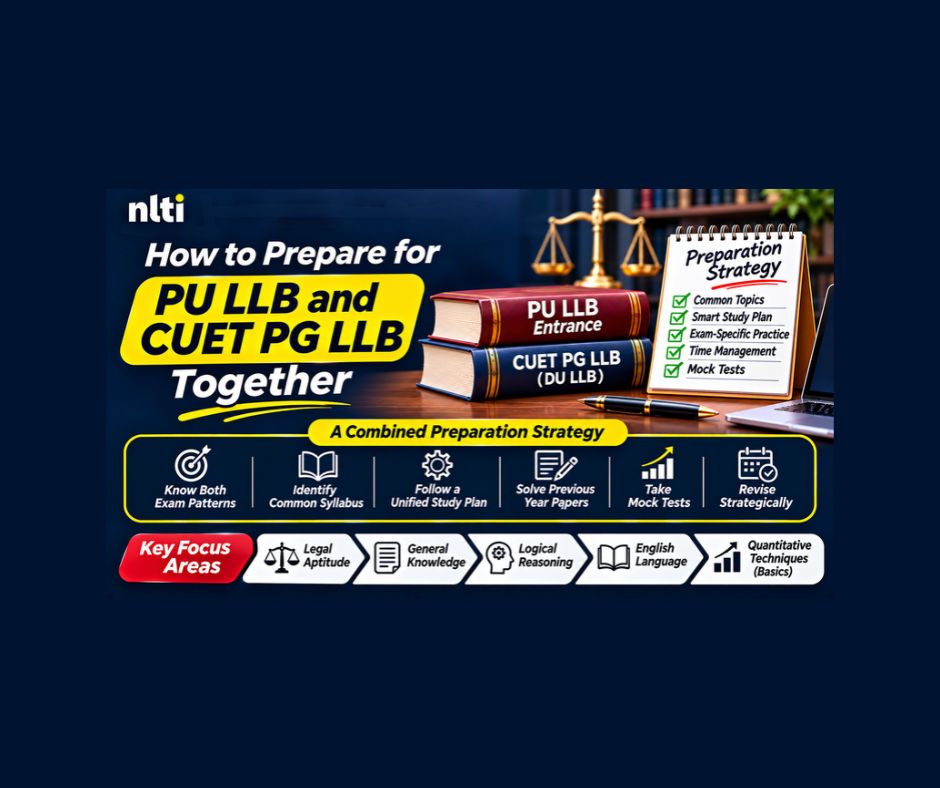
You can prepare for both exams with one timetable. Study English, reasoning and overlapping GK together. Set aside separate time for PU Legal Aptitude and CUET Computer Basics and maths.
Below you’ll find an eight-week plan, weekday schedules for one or two hours of study, and a mock tracker to help you decide what to work on next.
If you have two hours after class, spend the first on a topic that helps with both papers. Then give the rest of the session a specific job. On Monday, that might be a PU Legal Aptitude set and a review of the questions you missed. On Tuesday, use the same slot for CUET computer shortcuts or percentages.
Best PU LLB Coaching 2027 By NLTI
PU LLB vs CUET PG LLB exam pattern
Both exams gave candidates 90 minutes in 2026. In PU, those minutes included filling in an OMR sheet for a 100-question paper. In CUET, you worked through 75 questions on a computer.
Which exam do you need for your target college?
PU LLB here means the entrance test for Panjab University’s three-year LL.B., including the Department of Laws in Chandigarh. COQP11 is the National Testing Agency’s CUET PG General Paper.
The University of Delhi mapped its three-year LL.B. to COQP11 in its 2026–27 admission bulletin. Before registering, write down your target programme, the required entrance test or paper code, and any separate university admission steps.
If you’re still building your shortlist, see NLTI’s guide to three-year LLB entrance exams in India.
Side-by-side comparison of the 2026 papers
Use these official 2026 patterns as a starting point for 2027 preparation. Check the dates, pattern and paper code again against the documents for your application cycle.
The averages are a pacing guide.
Answering a few quick GK questions in seconds buys you time for a longer reasoning set. For PU, use the published marks to plan your timed section practice. For CUET, use the COQP11 syllabus and the topics where you keep dropping marks.
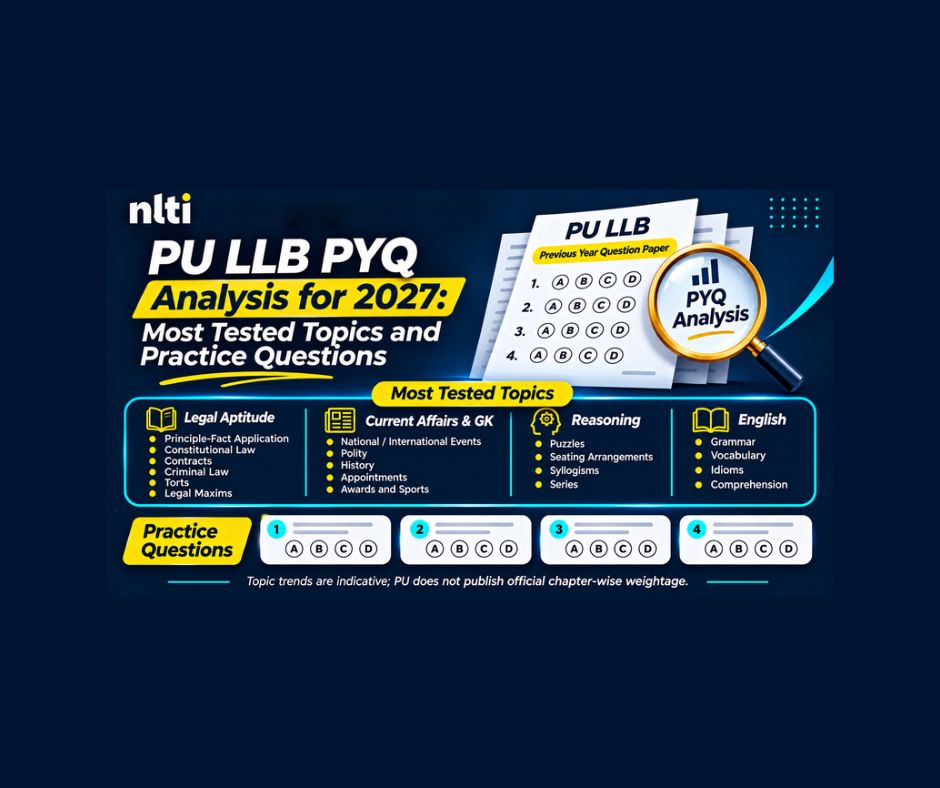
PU LLB PYQ Analysis 2027: Top Topics & Practice Questions
What can you study together?
If you’ve just revised sentence correction, try a few questions from each exam before you move on. You might know the grammar rule and still lose time spotting the error under pressure.
Shared English, reasoning and GK
For example, after revising fundamental rights, try one recall question about constitutional remedies.
Then apply a legal principle to a short fact pattern in a PU practice set. Record which of the two skills slowed you down. A missed fact calls for retrieval practice. A missed application calls for another worked problem.
What needs a separate study block?
PU Legal Aptitude
Legal Aptitude accounted for 40 of 100 marks in the 2026 PU paper. Make it a regular part of your PU LLB preparation strategy. Start with the prospectus sample questions, which include Constitution and contract questions. For each wrong answer, write the rule or fact you missed and answer a fresh question on the same point later in the week.
CUET Computer Basics and quantitative aptitude
Make a starter checklist for hardware and software, storage, shortcuts, and basic networking. For quantitative aptitude, begin with percentages, ratios, averages and time-and-work. Try a 10-question mixed drill with five computer questions and five quant questions.
Mark an error as a concept gap if you still cannot solve it without a timer. Mark it as a speed issue if you can solve it correctly with extra time. For a fuller breakdown, see NLTI’s CUET PG LLB preparation guide.
Pro tip
Give Computer Basics a recurring slot from week one. Small topics such as keyboard shortcuts are easy to postpone, and a ten-minute recall drill is easy to fit between longer sessions.
An 8-week study plan for both exams
If college or work makes your evenings unpredictable, look at next week’s calendar before you set a daily target. Three evenings you can reliably keep and one weekend mock give you a place to start.
Start with one diagnostic for each exam
Confirm your target colleges and required papers.
Take one recent paper or a pattern-matched mock for each exam.
Record your attempts, accuracy, raw score and any section where you ran out of time.
Schedule shared study blocks, then assign the two biggest gaps to exam-specific sessions.
Review both sets of results each week and change the timetable accordingly.
Copy this tracker for each mock. Calculate attempted accuracy by dividing correct answers by attempted questions.
Divide the eight weeks into three phases
Sample timetable for two hours on weekdays
With 60 minutes on weekdays, use 30 minutes for shared topics, 20 minutes for exam-specific practice and 10 minutes to review errors.
Keep a weekend block for the full mock. If you need help building a routine around work, use NLTI’s CUET PG LLB study schedule for working aspirants to adapt the CUET side of your timetable.
How to adjust when one exam comes first
In the final two weeks before the earlier paper, try directing 70% of exam-specific practice time to that paper and keeping 30% for the other. For example, with five hours of exam-specific time and CUET coming first, spend around three and a half hours on CUET and an hour and a half on PU.
Keep some shared revision in the week. Treat this split as a starting point and adjust it for your target college and recent scores. After the first exam, take a fresh timed sectional for the remaining paper and plan from that result.
How to use previous-year papers and mocks for both exams
Before you start a mock, decide what you want to learn from it. If you ran out of time on your last PU paper, use this one to see where the minutes went. Record the year or mock version so you can compare similar papers later.
Practise in each exam’s format
For PU, use a printed question booklet and an OMR practice sheet. Include bubbling time in the 90 minutes. Notice whether you lose time checking question numbers, and rehearse an approach that keeps them aligned. Start with PU’s official sample questions if you have yet to find a suitable full paper.
For CUET, practise on a screen. Rehearse moving past a slow question, returning to flagged items and leaving time to check responses. If you change your attempt order, test it across two or three comparable mocks to see whether accuracy and completion improve.
If you’re using past papers, check the year and paper code before scoring. An answer key helps verify responses when you have the matching questions.
Turn an error log into next week’s timetable
Worked example of a mock review
Suppose you answer 50 of 60 attempted CUET questions correctly. Under the 2026 marking scheme, that’s 190/300 and roughly 83% attempted accuracy. If six of your ten mistakes came from computer shortcuts and networking, schedule two short drills and a timed retest.
Now imagine your PU mock shows four legal recall errors and three rushed reasoning answers. Give your next PU block two measurable tasks: recall the missed legal rules from memory and redo a short reasoning set under time pressure. Compare each raw score with earlier scores from the same exam. Use accuracy and time taken to spot patterns across both tests.
Common mistake
Writing “revise GK” in your error log leaves a decision for later. Write the topic, why you missed it and what you’ll do. For example, “Mixed up two constitutional bodies. Make a comparison card and retest on Friday.”
Check Out CUET PG LLB Online Coaching and Mentorship
Why Trust NLTI
National Law Training Institute has worked with law entrance aspirants since 2022. It was founded by students of NLSIU Bengaluru and offers coaching and mentorship for law entrance exams, including CUET PG LLB.
At NLTI, we use mock review to help students decide what to practise the following week. The two-exam timetable follows the same idea. Start with the hours you have and give recurring mistakes a place in the schedule. About NLTI
How mentorship fits into a two-exam plan
Bring your target colleges, weekly availability and one mock result for each exam. A review can help you decide which mistake to fix first and what to retest.
If you keep losing CUET marks on Computer Basics and your PU errors are concentrated in Legal Aptitude, give each a short, focused block with a measurable goal.
If you want structured support for the CUET side, see NLTI’s CUET PG LLB coaching and test series.
Start your first week of preparation
What to do today
Write down your target colleges and verify the entrance route and paper code.
Block two diagnostic sessions. If you only have one long session this weekend, start with the exam that comes first and schedule the second.
Put one shared session, one PU Legal Aptitude drill and one CUET Computers or Quant session on the calendar.
After your first mocks, pick one recurring error per exam and schedule a retest.
Once your first two mock sessions are on the calendar, you have a plan for the week. For CUET classes, mocks and mentorship, explore NLTI’s CUET PG LLB coaching.
FAQs about preparing for PU LLB and CUET PG LLB together
1. Can I prepare for PU LLB and CUET PG LLB at the same time?
Yes. Combine English, reasoning and overlapping GK, then reserve separate blocks for PU Legal Aptitude and CUET Computer Basics and quantitative aptitude. Use full mocks in each exam’s format.
2. What subjects overlap in PU LLB and CUET PG LLB?
English, reasoning and parts of general knowledge overlap. Constitution basics also carry over. Use the listed COQP11 topics and the PU prospectus sample questions to choose drills for each exam.
3. Is Legal Aptitude required for both exams?
PU gives Legal Aptitude a dedicated 40-mark component in its 2026 pattern. CUET COQP11 lists legal awareness and the Indian Constitution under General Knowledge/Awareness. Prepare that shared foundation, then use a separate set for PU Legal Aptitude.
4. Do I need maths and computers for CUET PG LLB?
Yes, if your programme requires COQP11. NTA lists Computer Basics and quantitative topics such as percentages, averages and ratios. Start with a short diagnostic drill in each area and schedule more time for the one costing you marks.
5. Can I use CUET PG LLB mocks for PU LLB?
Use CUET material for overlapping topic drills. Take a dedicated PU mock for full-paper practice so you can rehearse Legal Aptitude, PU pacing and OMR bubbling under the 90-minute limit.
6. Is two hours a day enough to prepare for both?
Two hours can support a workable routine. Your starting level and the time to your exams determine how much ground you can cover. Start with 60 minutes of shared topics, 40 minutes of exam-specific work and 20 minutes of review. Use your diagnostic results to adjust the balance.
7. Do I need COQP11 for every three-year LLB programme offered through CUET PG?
Check the paper code against the admission bulletin for each university and programme. DU used COQP11 for its three-year LL.B. in 2026–27. Confirm the code and university application steps for your own admission cycle.
Related reading · If NLSIU Bengaluru is also on your shortlist, see NLTI’s CUET PG LLB vs NLSAT comparison.
Suggested internal links used
Key takeaways
Revise shared English, reasoning and GK once, then test those skills in each paper’s format.
Protect regular blocks for PU Legal Aptitude and CUET Computers and Quant.
Use separate mocks, review the errors that cost the most marks, and give the nearer exam more timed practice.
Get In Touch
Have questions? We'd love to hear from you. Send us a message and we'll respond as soon as possible.