CLAT 2028 Legal Reasoning: Topics & Preparation Tips
Share this article:
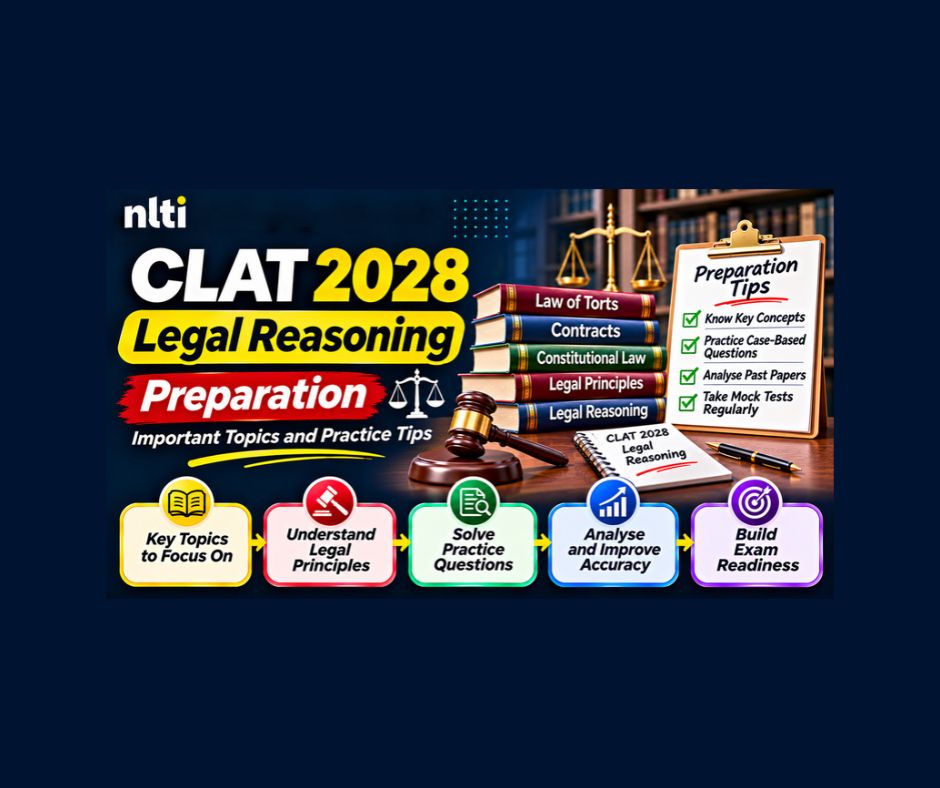
Legal Reasoning is the section aspirants fear most and prepare for least wisely. Many students assume it needs deep legal knowledge, so they buy thick law books. In reality, CLAT 2028 legal reasoning rewards careful reading and clean thinking far more than memorised law.
This guide shows what the section tests, which topics appear most, how to solve each question type and how to practise so your accuracy keeps rising.
Best CLAT Coaching Online 2027–2028 by NLTI
What Is CLAT 2028 Legal Reasoning?
There is no separate CLAT 2028 syllabus yet, so the best guide is the Consortium's published CLAT 2027 syllabus, which the Consortium kept unchanged. For Legal Reasoning it says:
The Expert Committee proposed merging Legal and Logical Reasoning into one section but that is only a proposal. Whatever the final format, CLAT 2028 legal reasoning skills carry over directly because both parts test how you apply a stated rule.
Question Types in CLAT 2028 Legal Reasoning
Analyses of recent papers show that a few question types dominate. Learn to recognise each one.
Principle-and-fact questions have historically been the most common, with inference questions growing over the years.
In the CLAT 2026 paper, reports describe about 30 legal questions, with some analysts noting a few that leaned on legal general knowledge. That is why CLAT 2028 legal reasoning preparation should include a small dose of legal news.
CLAT English Preparation 2027: Tips to Score Higher
Important Topics for CLAT 2028 Legal Reasoning
You do not need to master a law textbook. You need working familiarity with the ideas passages keep returning to.
Treat this list as a map of ideas, not a syllabus to memorise. Questions usually state the relevant principle inside the passage, so your job in CLAT 2028 legal reasoning is to read it precisely and apply it faithfully.
A Five-Step Method for CLAT 2028 Legal Reasoning
A repeatable method beats intuition. Use these steps on every principle-and-fact question:
Step 1, read the principle: underline each condition and any exception.
Step 2, extract the facts: note who did what and when.
Step 3, test every condition: does the fact meet each part of the rule?
Step 4, eliminate options: remove any that add facts or use outside law.
Step 5, choose the closest fit: pick the option that follows the passage's rule.
This method turns a vague feeling into a checklist. With practice, it takes less than a minute per question, which matters in a two-hour paper.
A Worked Example for CLAT 2028 Legal Reasoning
Here is an original practice question, not from any paper, to show the method in action.
Principle: A person who carelessly causes harm to someone they owe a duty of care is liable for negligence, unless the harm was not reasonably foreseeable.
Facts: A shopkeeper mops the floor but puts no warning sign. A customer slips and breaks her wrist.
Walk-through: check each condition. The shopkeeper owes customers a duty of care. Leaving a wet floor unmarked is careless. The harm, a slip, was reasonably foreseeable. Every condition is met, so the shopkeeper is liable. Notice that no law was memorised instead the passage's rule did all the work. This is the habit that wins marks in CLAT 2028 legal reasoning.
Rule-change twist: now suppose the principle adds, "unless a clear warning was displayed." The answer changes only if the facts show a warning. Practising these small shifts prepares you for the "what if the rule changed" questions that appear in CLAT 2028 legal reasoning.
Traps That Cost Marks in CLAT 2028 Legal Reasoning
Using real-world law: answer on the passage's principle, even if you know the actual law differs.
Adding facts: options sometimes assume details the question never gave.
Missing the exception: one clause can reverse the answer.
Letting opinion decide: a moral view is not a legal principle.
Rushing the last option: read all four before choosing.
CLAT 2027: 30-Day Strategy Based on Mock Scores
A Practice Plan for CLAT 2028 Legal Reasoning
With about a year to go, spread your practice across three stages. The months are suggestions, not official dates.
Begin with untimed practice because accuracy comes before speed. Our legal reasoning strategy explains how to build that speed.
A Weekly Routine for CLAT 2028 Legal Reasoning
Monday to Friday: two passages a day, with full review of each answer.
Saturday: one timed sectional test.
Sunday: revise the error log and read the week's legal news.
35 to 50 minutes a day is enough in the early months. The point of CLAT 2028 legal reasoning practice is consistency, not marathon sessions.
Keep an Error Log for CLAT 2028 Legal Reasoning
Every wrong answer teaches something but only if you label it. After each practice set, tag mistakes:
Misread principle: you missed a condition or exception.
Outside knowledge: you answered from real law, not the passage.
Added fact: you assumed something not stated.
Time pressure: you rushed and slipped.
Within a month, two or three tags will dominate. Fix those first and your CLAT 2028 legal reasoning score will climb faster than it would from extra reading.
Use Legal News to Strengthen CLAT 2028 Legal Reasoning
Legal current affairs links two sections at once. Follow Supreme Court and High Court decisions, noting the issue, the ruling, and the reasoning. Mark each story as decided, referred or pending. Over months, you will absorb how courts weigh rights, duties and public interest, which is exactly the thinking passages reward.
CLAT Exam Centers 2027: State & City-Wise List
Books and Resources for CLAT 2028 Legal Reasoning
Keep your CLAT 2028 legal reasoning resources short. One principle-and-fact practice book, previous year papers, a Constitution bare act for reference and a legal news source are enough. Many students recommend A.P. Bhardwaj's legal aptitude book as a starting point. Finish one source before buying another. Our section-wise books guide compares options.
If the Section Merges: What Changes for CLAT 2028 Legal Reasoning?
If the Consortium adopts the proposed merged section, legal and logical questions would sit together. You would still face rules to apply, arguments to analyse and inferences to draw. So CLAT 2028 legal reasoning practice would not be wasted.
You would simply add argument analysis, such as spotting assumptions and conclusions, to your routine. Preparing both now is the safest way to handle CLAT 2028 legal reasoning under either pattern.
CLAT 2028 Current Affairs & GK Preparation Guide
Mistakes to Avoid in CLAT 2028 Legal Reasoning Preparation
Memorising bare acts instead of practising CLAT 2028 legal reasoning passages.
Skipping previous year papers.
Practising only easy passages.
Ignoring the error log.
Waiting for the final pattern before starting CLAT 2028 legal reasoning practice.
Prepare for CLAT 2028 Legal Reasoning With NLTI
At NLTI, we help students build CLAT 2028 legal reasoning accuracy with structured classes, daily passage practice and mentors who review your error log. Track pattern updates in our CLAT 2028 exam pattern guide, then explore NLTI's CLAT coaching and start your preparation today.
FAQs
1. Do I need law knowledge for CLAT 2028 legal reasoning?
No and CLAT 2028 legal reasoning questions are built to be solved from the passage. The official syllabus says prior legal knowledge is not required, though awareness of legal and moral issues helps.
2. How many questions does CLAT 2028 legal reasoning carry?
About 28 to 32 of 120 questions in the current pattern.
3. Will CLAT 2028 legal reasoning change?
The committee proposed merging it with Logical Reasoning but this is not final. The skill of applying rules stays central.
4. How many passages should I practise daily for CLAT 2028 legal reasoning?
Start with two a day and increase gradually, reviewing each one.
5. Is legal current affairs important for CLAT 2028 legal reasoning?
Yes. It builds awareness and helps in both the legal and current affairs sections.
Read Next on NLTI
Get In Touch
Have questions? We'd love to hear from you. Send us a message and we'll respond as soon as possible.