CLAT 2028 Logical Reasoning: Preparation Guide
Share this article:
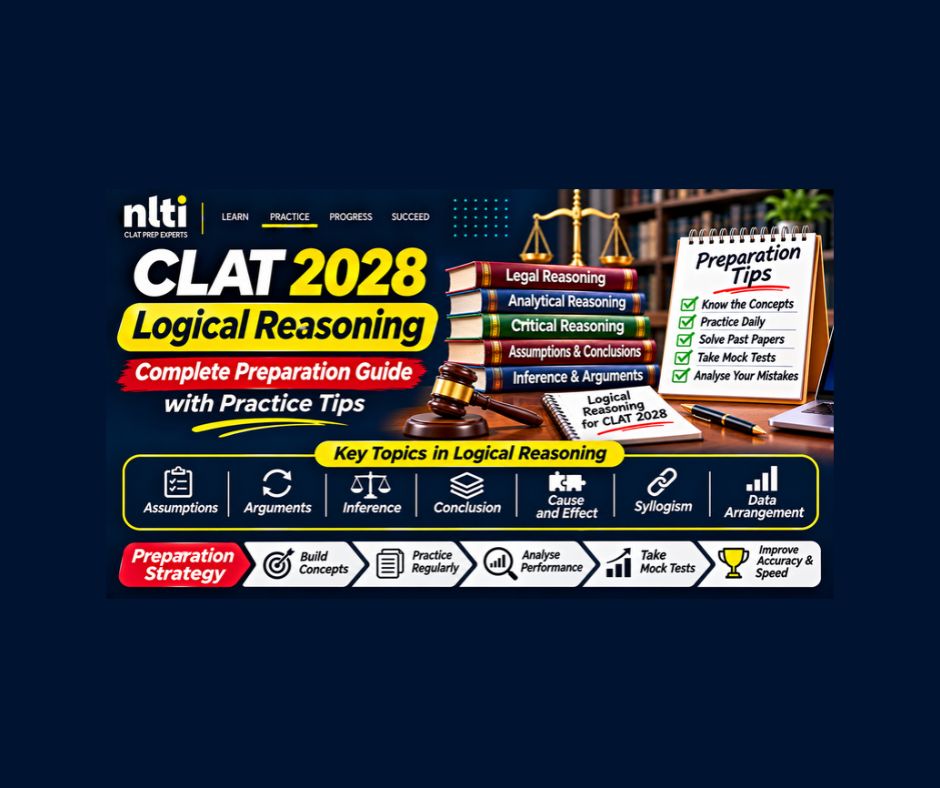
Logical Reasoning surprised many aspirants in the last cycle. Students who had drilled one style of question met another on exam day and scores slipped. The lesson for CLAT 2028 logical reasoning preparation is clear: build skills that work in any format instead of tricks for one.
This guide explains what the section tests, what CLAT 2026 revealed, which topics matter and how to practise week by week.
Best CLAT Coaching Online 2027–2028 by NLTI
What Does CLAT 2028 Logical Reasoning Preparation Cover?
No separate CLAT 2028 syllabus exists yet and the Consortium kept the CLAT 2027 pattern unchanged. So the official CLAT 2027 syllabus is the best guide for now.
That makes the section roughly one-fifth of the paper. Strong CLAT 2028 logical reasoning preparation therefore lifts your score and your rank directly.
What CLAT 2026 Taught Us About CLAT 2028 Logical Reasoning Preparation
The official syllabus stresses arguments, yet coaching analyses of CLAT 2026 described a section that leaned analytical. Reports mention sets on arrangements, deduction, blood relations and scheduling and several called it the most surprising and toughest part of the paper.
Accounts differ on exact counts, so treat the details as indicative.
Nobody can promise which style CLAT 2028 will favour.
The safe approach to CLAT 2028 logical reasoning preparation is to train both. NLTI's CLAT 2026 analysis discusses this shift and our guide to scoring high in logical reasoning covers both styles.
Important Topics for CLAT 2028 Logical Reasoning Preparation
Use this table as a checklist. Tick off each area only when you can solve its questions without hints. Start CLAT 2028 logical reasoning preparation with the first five rows because the official syllabus names arguments and add the puzzle rows next.
CLAT English Preparation 2027: Tips to Score Higher
A Four-Step Method for CLAT 2028 Logical Reasoning Preparation
Use these steps on every argument question:
Step 1, find the conclusion: look for signals such as therefore, so and hence.
Step 2, list the premises: these are the reasons offered in support.
Step 3, find the gap: name the unstated assumption linking premise to conclusion.
Step 4, test each option: does it fill the gap, widen it or break it?
This method anchors CLAT 2028 logical reasoning preparation in structure rather than gut feeling.
A Worked Example
Here is an original practice argument, not from any paper.
Argument: Cycling accidents in a city fell after new bike lanes opened. So the lanes made cycling safer.
Walk-through: the conclusion is that the lanes made cycling safer. The premise is that accidents fell afterwards. The gap is the assumption that the lanes caused the fall. Now test two options.
The fact that far fewer people cycled after the lanes opened weakens the argument because fewer cyclists could explain fewer accidents. The fact that accidents fell only on streets with lanes, while ridership stayed the same, strengthens it. Notice how the answer depends on the gap, not on whether the conclusion sounds sensible. That is the thinking CLAT 2028 logical reasoning preparation should build.
How to Solve Analytical Sets in CLAT 2028 Logical Reasoning Preparation
Puzzle sets reward patience, so build this habit early in your CLAT 2028 logical reasoning preparation.
Read every condition first: do not start drawing after the first line.
Place fixed facts first: start with statements that pin down one position.
Branch on the strictest condition: it limits the possibilities fastest.
Keep one clean diagram: rough work should still be readable.
Check against all conditions: one broken rule rules out an option.
CLAT 2027: 30-Day Strategy Based on Mock Scores
Traps That Cost Marks in CLAT 2028 Logical Reasoning Preparation
True but irrelevant: an option can be correct in the real world and still miss the question.
Outside facts: answer only from the passage.
Must versus could: "must be true" is far stricter than "could be true".
Missed qualifiers: words such as some, most and only change the logic.
One set eating the clock: leave a stubborn puzzle and return if time allows.
Remember that each wrong answer costs 0.25 marks, so informed skipping is part of CLAT 2028 logical reasoning preparation. Our negative marking strategy explains how to decide.
A Practice Plan for CLAT 2028 Logical Reasoning Preparation
With about a year to go, spread your CLAT 2028 logical reasoning preparation across three stages. The months are suggestions, not official dates.
Review each stage of your CLAT 2028 logical reasoning preparation against your error log before moving on. Begin untimed because accuracy comes before speed. Add a time limit once your method is steady. A two-hour paper leaves little room for slow habits, so see how to complete the paper in two hours.
A Weekly Routine for CLAT 2028 Logical Reasoning Preparation
Monday, Wednesday, Friday: one argument set with full review.
Tuesday and Thursday: one analytical set, solved with a clean diagram.
Saturday: one timed sectional test.
Sunday: revise the error log and redo missed questions.
30 to 45 minutes a day is enough early on. Consistency matters more than marathon sessions in CLAT 2028 logical reasoning preparation.
Keep an Error Log for CLAT 2028 Logical Reasoning Preparation
After each set, tag every wrong answer:
Missed the gap: you did not spot the assumption.
Outside fact: you used real-world knowledge.
Diagram error: you misplaced a condition.
Time pressure: you rushed and slipped.
Within a month, two or three tags will dominate. Fix those first. A good error log makes your CLAT 2028 logical reasoning preparation faster than extra reading ever could. Our guide to reviewing mock tests shows how.
Books and Resources for CLAT 2028 Logical Reasoning Preparation
Keep resources for CLAT 2028 logical reasoning preparation short. One book on critical reasoning, one on puzzles and arrangements, previous year papers and a set of mock tests are enough. Finish one source before buying another.
Previous papers matter most because they show how the Consortium actually phrases questions. Our section-wise books guide compares options.
If the Section Merges: What Changes for CLAT 2028 Logical Reasoning Preparation?
The Expert Committee proposed merging Logical Reasoning with Legal Aptitude but this is only a proposal. If it happens, argument analysis would become even more important because legal passages also ask you to apply stated rules.
Your CLAT 2028 logical reasoning preparation would still carry over. You would simply add rule-application practice from legal passages. Track updates in our CLAT 2028 exam pattern guide.
Mistakes to Avoid in CLAT 2028 Logical Reasoning Preparation
Preparing only one style of logical reasoning.
Skipping previous year papers.
Treating CLAT 2028 logical reasoning preparation as a last-month task.
Reading solutions without attempting the set first.
Ignoring the error log.
Waiting for the final pattern before starting CLAT 2028 logical reasoning preparation.
CLAT Exam Centers 2027: State & City-Wise List
Prepare for CLAT 2028 Logical Reasoning With NLTI
At NLTI, we help students build CLAT 2028 logical reasoning preparation around concepts, daily practice and regular mock tests. Pair this guide with our CLAT 2028 overview, then explore NLTI's CLAT coaching and start your preparation today.
FAQs
1. What is the best way to start CLAT 2028 logical reasoning preparation?
Begin with argument structure: conclusion, premises and assumptions. Then add simple puzzles and practise untimed until your method is steady.
2. How many questions should CLAT 2028 logical reasoning preparation aim to attempt?
The section carries about 22 to 26 of 120 questions in the current pattern. Because of the 0.25 penalty, attempt the ones you can solve accurately.
3. Will CLAT 2028 logical reasoning preparation change if the pattern changes?
The committee proposed merging it with legal reasoning but this is not final. Argument analysis and rule application stay central either way.
4. Should CLAT 2028 logical reasoning preparation focus on puzzles or arguments?
Both. The syllabus stresses arguments, while CLAT 2026 reports describe analytical sets.
5. How much time should CLAT 2028 logical reasoning preparation take daily?
30 to 45 minutes is enough in the early months, with a weekly timed test.
Read Next on NLTI
Get In Touch
Have questions? We'd love to hear from you. Send us a message and we'll respond as soon as possible.