NLSAT 2027: 12 Preparation Mistakes That Cost Seats
Share this article:
Nov 23, 2026
By the NLTI NLSAT Mentorship Team · Facts checked against the NLSIU admissions notification · Last updated November 2026
Summary: NLSAT 2027 is on April 25, 2027, and applications close March 23, 2027. The biggest preparation mistakes are treating it like CLAT, leaving Part A questions blank (each blank costs 0.25 marks), neglecting Part B, memorising law instead of applying principles, and taking mocks without reviewing them.
· Never leave a Part A question blank. A reasoned guess beats a guaranteed -0.25.
· Part A is the gate. Part B is evaluated only for candidates shortlisted at about 1:5 per seat.
· Part B decides your rank. Practise written legal reasoning and a ~500-word essay by hand from week one.
· Review every mock. Keep a mistake log and solve the last 3 NLSAT papers under timed conditions.
· Check eligibility now. 45% (General) or 40% (reserved categories) in graduation; final-year students can apply.
Check Out NLSAT Coaching and Mentorship by NLTI
Here's a pattern we keep seeing in mock reviews. A well-read aspirant finishes Part A feeling good. They skipped the eight or nine questions they weren't sure about, "to be safe." Then the score comes back lower than expected.
The reason surprises almost everyone. In NLSAT, a blank answer costs you exactly as much as a wrong one: 0.25 marks. Those nine "safe" skips quietly took 2.25 marks away. In an exam where Part A decides whether your essay is even read, that can be the whole gap.
That's the thing about NLSAT 2027 preparation mistakes. Most of them aren't about knowledge. They're habits. Many come from CLAT prep, or from tips written for a completely different exam.
NLSAT doesn't reward what CLAT rewards. It penalises blanks. It locks your Part B behind your Part A score. And it wants you to reason like a lawyer, not recite law like a textbook.
In this guide, you'll find the 12 mistakes we see most often, what each one costs, and exactly how to fix it. You'll also get a 5-month plan and a quick self-check list.
The clock is real. NLSAT 2027 is on April 25, 2027, and applications close on March 23, 2027. That's roughly 22 weeks from late November. Enough time to fix every mistake below, if you start now.
If you want the full picture first, our complete NLSAT 2027 study plan covers the syllabus and schedule end to end. This post is about what not to do.
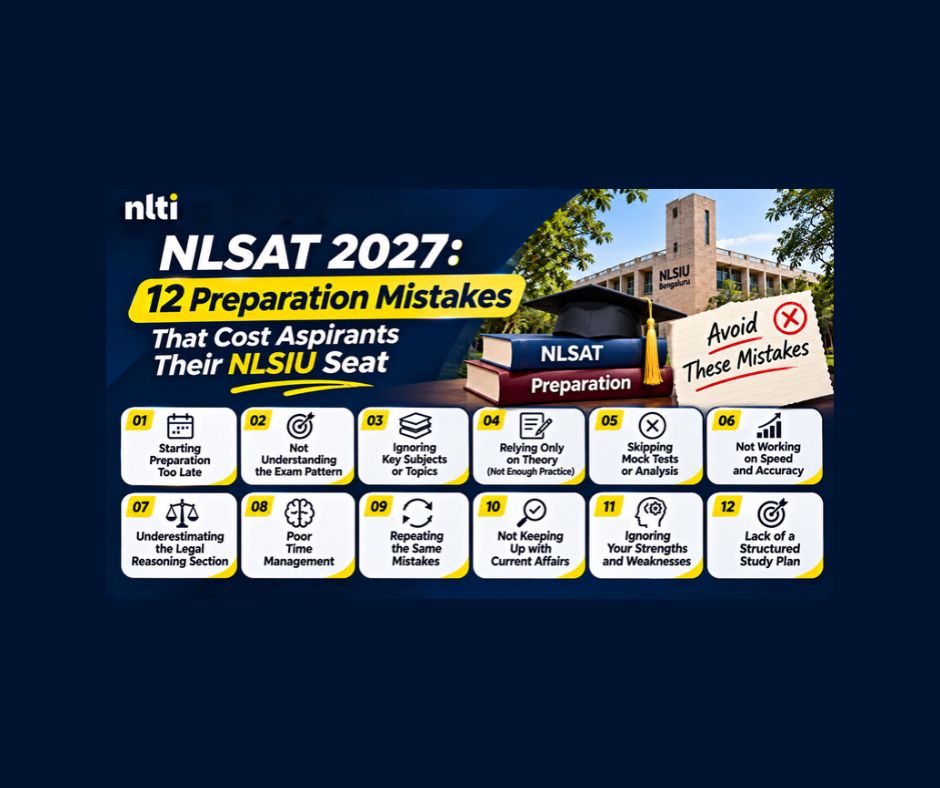
The 12 NLSAT Mistakes at a Glance
Quick answer: The most common NLSAT 2027 preparation mistakes are treating NLSAT like CLAT, leaving Part A questions blank, neglecting either Part A or Part B, memorising law instead of applying principles, weak reading stamina, shallow current affairs, unstructured essays, and taking mocks without reviewing them. Each has a simple, specific fix.
NLSAT 2027 in 60 Seconds: What You're Actually Up Against
You can't avoid mistakes in an exam you only half understand. So before we get to them, here's the paper in one screen. For a deeper walk-through, see our guide to the NLSAT 2027 exam pattern and marking scheme.
What is NLSAT? The National Law School Admission Test (NLSAT) is the entrance exam conducted by the National Law School of India University (NLSIU), Bengaluru, for its 3-Year LL.B. (Hons.) and other selected programmes. It's a 150-mark, pen-and-paper test with an objective Part A and a subjective Part B.
Part A: 75 MCQs, 75 marks
Part A covers three areas: Reading Comprehension, General Awareness and Critical Reasoning. Each correct answer earns 1 mark. Each wrong answer costs 0.25 marks. So does each question you leave unanswered.
It's also passage-heavy. Analyses of the NLSAT 2026 paper report 8 passages carrying 75 questions, with Part A rated the hardest part of the paper.
Part B: 10 legal reasoning answers + 1 essay, 75 marks
Part B is written. Current sources describe 10 legal reasoning questions worth 6 marks each (60 marks) and one analytical essay worth 15 marks. For the essay, you pick one of three topics and write around 500 words. There's no negative marking here, but there's also nowhere to hide weak reasoning.
You don't need a law degree. The questions give you a legal principle and a set of facts, and test how well you apply one to the other.
The 1:5 shortlisting rule that decides whether your essay is even read
This is the rule most aspirants underrate. NLSIU evaluates Part B only for candidates shortlisted on their Part A score, at about five candidates per seat. Your final merit list position then comes from Part A and Part B combined.
In plain terms: Part A gets you in the door. Part B decides where you sit. A brilliant essay can't help you if your Part A score misses the shortlist.
Key dates and eligibility for 2027
Always confirm dates, fees and eligibility on the official NLSIU admissions portal. Third-party sites, including this one, can lag behind a notification update.
Quick summary: 150 marks, two parts, one gate. Blanks cost marks in Part A. Part B is read only if Part A clears the 1:5 shortlist.
NLSAT 2027 Current Affairs: Legal & National Issues
Strategy Mistakes (the Ones That Sink You Before You Start)
These three mistakes happen before you open a single book. They decide what you study, how you attempt the paper and where your hours go. Get them wrong, and hard work just takes you further in the wrong direction.
Mistake 1: Treating NLSAT Like CLAT for Graduates
Why it happens
Both exams are reading-heavy. Both lead to a National Law School. Most coaching material is built for CLAT. So it feels natural to assume NLSAT is "CLAT, but older." It isn't.
What it costs you
Aspirants who copy CLAT routines spend weeks on things NLSAT barely rewards. Think static legal GK lists, quantitative drills and speed-reading tricks. Meanwhile, they barely practise written legal reasoning or essays, which make up half the paper.
The fix: know exactly how the two differ
If you're switching from CLAT, keep your reading habit and drop the rest.
Mistake 2: Leaving Questions Blank to "Play Safe"
Should you leave questions blank in NLSAT? Usually, no. In NLSAT Part A, an unanswered question costs 0.25 marks, the same as a wrong answer. A correct answer earns 1 mark. So a reasoned guess almost always beats a blank. Part B has no negative marking.
The rule
+1 for correct. -0.25 for wrong. -0.25 for unanswered. That third line is what CLAT-trained aspirants miss. In CLAT, a blank is free. In NLSAT, it's a guaranteed loss.
The maths, worked out
Assume a question has four options. (Check this against the latest official paper; the logic holds for any number of options.)
Now go back to the aspirant in our introduction.
Nine blanks cost 2.25 marks. Even nine blind guesses would have averaged about +0.56. That's a swing of nearly 3 marks from one habit.
The fix
Attempt every question. No exceptions.
On doubtful ones, eliminate first, then pick. Even one ruled-out option improves your odds a lot.
Keep the last 3 minutes of Part A to fill in any you've skipped. Never leave a bubble empty.
Pro tip: Practise this in mocks, not just on exam day. Mark doubtful questions with a small dot, finish the paper, then return. You'll see how much the last-minute fill-in adds.
Want to see how much blanks are costing you right now? Take a free NLSAT diagnostic mock and compare your attempted vs skipped score.
Mistake 3: Getting the Part A / Part B Balance Wrong
This mistake shows up in two opposite forms. Both hurt.
Over-investing in essays while Part A is weak
Some aspirants, often strong writers, pour their time into essays and legal answers. But Part A is the gate. If it misses the 1:5 shortlist, nobody reads your Part B at all.
Ignoring Part B until March
Others treat Part A as "the real exam" and leave writing for the last six weeks. Then they discover that writing a clear 6-mark legal answer in a few minutes takes months to build. Part B carries half the marks and decides your final rank.
The fix: split your hours by phase
Adjust after every mock.
If your Part A score is below the range you need for the shortlist, shift time back to it. For what each part covers in detail, see our Part A and Part B syllabus breakdown.
Key takeaways: NLSAT isn't CLAT. Never leave a Part A question blank. Train both parts from the start, but protect Part A first.
Section-Specific Mistakes
Once your strategy is right, the next set of mistakes hides inside each section. These are the ones that show up in mock after mock, even among well-prepared aspirants.
NLSAT 2027 Important Topics: What Should You Study First?
Mistake 4: Memorising Law Instead of Applying Principles
Do you need legal knowledge for NLSAT? No. NLSAT doesn't require prior legal knowledge. Part B gives you a legal principle and a set of facts. It tests whether you can apply that principle to those facts and reach a clear, reasoned conclusion in writing.
What Part B legal reasoning actually tests
Many aspirants, especially those without a law background, panic and start memorising landmark judgments, Latin maxims and articles of the Constitution of India. It feels productive. But the question isn't "what does the law say?" It's "given this rule, what happens to these people?"
Example: a weak vs a strong answer
Principle: A person who voluntarily accepts a known risk cannot claim damages for harm arising from that risk.
Facts: Meera buys a ticket to a cricket match and sits in the open stands. A batter hits a six, and the ball injures her. She sues the organisers.
Weak answer: "This is volenti non fit injuria, a well-known doctrine. Courts have applied it in many sports cases. So Meera cannot claim damages."
It names a doctrine and jumps to the end. It never shows the reasoning.
Strong answer: "The issue is whether Meera accepted the risk that injured her. A ball entering the stands is an ordinary, known risk of watching cricket. By choosing to buy a ticket and sit in the open stands, she voluntarily accepted that risk. The injury arose from exactly that risk. Applying the principle, Meera cannot claim damages from the organisers."
Notice the strong answer uses only the principle given. It moves step by step and ends with a clear conclusion.
The fix: a 4-step answer frame
Issue: state the question in one line.
Principle: quote or restate the rule given.
Application: match each element of the rule to a specific fact.
Conclusion: answer the question directly.
Practise this on short problems every day, and the frame will become automatic by March.
Mistake 5: Underestimating Reading Stamina
The NLSAT 2026 paper reportedly packed 75 questions into 8 passages. That's a lot of dense reading under time pressure. Aspirants who only practise one passage at a time often fade by passage six. Their accuracy drops just when it matters.
The fix: build stamina in stages
December: 2 timed passages a day, from editorials, long-form journalism or policy writing.
January to February: 4 passages in one sitting, 3 to 4 times a week.
From February: full-length Part A sets under exam timing.
Track accuracy on your last two passages separately. If it's clearly lower than on your first two, stamina is the problem, not comprehension.
Pro tip: Read material slightly harder than what you enjoy. Long-form legal and policy writing is closer to NLSAT's level than quick news summaries.
Mistake 6: Reading the News Without Analysing It
Headlines vs issues
Memorising who won what and which bill passed helps with a few General Awareness questions. But it does little for the essay or reasoning. Those reward understanding of an issue: why it matters, who's affected and what the strongest arguments are on each side.
The fix: a weekly "one issue, three sides" note
Each week, pick one issue from current affairs for law entrance prep. Write one page with three headings:
Facts: what happened, who decided it, what the law or policy says.
For: the strongest arguments supporting it.
Against: the strongest arguments opposing it.
Take an issue like regulating AI-generated deepfakes. A headline tells you a rule was proposed. A three-sides note tells you the free speech concerns, the privacy and fraud harms, and the enforcement problems. That's essay material.
By April, you'll have around 20 notes. That's a ready bank of essay arguments.
Mistake 7: Writing Essays With No Structure or Word Budget
How long should the NLSAT essay be? Around 500 words. Current sources describe one analytical essay worth 15 marks, chosen from three topics. Aim for a clear thesis, two well-developed arguments, one counter-argument with a response, and a short conclusion, all within the word limit.
Common errors
No clear thesis, so the essay drifts.
A one-sided argument that ignores obvious objections.
Running well over length, which eats into time for the other questions.
Picking the topic you like most instead of the one you can argue best.
The fix: plan for 5 minutes, then write to a skeleton
Mistake 8: Practising Only on Screen for a Pen-and-Paper Exam
NLSAT is an offline, pen-and-paper exam. Yet many aspirants type all their practice answers. On the day, they find their handwriting is slower, messier and harder to read than they expected.
Why it matters in Part B
Part B is marked by a human reader. Clear, readable answers are easier to follow and to credit. Writing speed also decides whether you finish all ten legal reasoning answers and the essay.
The fix
Handwrite every Part B practice answer from January.
Time yourself: note how many words you write in 10 minutes, and build it up.
Use short paragraphs and leave space between steps of your answer, so the examiner can follow it.
Key takeaways: Apply principles, don't recite law. Build reading stamina deliberately. Analyse issues, not headlines. Plan every essay. Practise by hand.
NLSAT 2027 Exam Date: Important Dates, Eligibility, Pattern and Preparation
Practice and Mock-Test Mistakes
Mocks are where preparation turns into marks. They're also where most time gets wasted. Taking a mock is easy. Learning from it is the hard part.
Mistake 9: Taking Mocks Without a Mistake Log
Here's a familiar story. An aspirant takes a mock every Sunday, checks the score, feels good or bad, and moves on. By March, they've taken 15 mocks. Their score has barely moved. Why? Because they've made the same five mistakes fifteen times.
A simple mistake log
Sort your errors into three buckets: didn't know, misread, and ran out of time. Each bucket needs a different fix.
The fix: spend as long analysing as attempting
If a mock takes 150 minutes, give it another 150 minutes of review. Go through every wrong answer, every guess and every blank. Then write down one specific change for the next mock.
How many mock tests for NLSAT are enough? Quality beats quantity. Around 15 to 20 full-length mocks, each properly reviewed, is a sensible target between January and April.
Pro tip: Review Part B answers with a partner or mentor. You can't easily spot a missing step in your own reasoning.
Mistake 10: Skipping Previous Year Papers or Using Generic CLAT Material
What past NLSAT papers reveal
Previous year papers are the closest thing to the real exam. They show you the passage length, how dense the reading is, how General Awareness is tested and what a typical Part B principle looks like. Generic CLAT books can't show you that.
They also calibrate your expectations. Knowing that the NLSAT 2026 Part A was widely rated difficult helps you stay calm when a passage feels hard in April. Hard is normal.
The fix
Solve at least the last 3 NLSAT papers under full timed conditions.
Do them in February and March, after you've built some stamina, so you get a real reading.
Compare each paper's passages and principles with your mock material. If they don't match, change your material.
Key takeaways: A mock without review is just a score. Keep a mistake log. Use real NLSAT papers to calibrate your preparation.
Exam-Day and Admin Mistakes
These last two mistakes have nothing to do with how much you know. That's exactly why they're so painful. Months of work can slip away in one rushed hour or one missed email.
Mistake 11: No Time Plan for the 150 Minutes
Without a plan, most aspirants overspend on the passages they find hard. They reach the end of Part A with questions left, or start Part B with too little time for ten answers and an essay.
A sample time plan
Some sources describe a 75-minute split for each part. Confirm the timing rules on your admit card, then adapt this:
Practise this exact plan in your last 6 to 8 mocks. On the day, you shouldn't be deciding anything about timing.
Pro tip: Write your checkpoint times (for example, "passage 4 done by 10:35") at the top of your rough sheet as soon as you're allowed to.
NLSAT 2027 Preparation Plan: 6-Month Study Timetable
Mistake 12: Missing Eligibility and Deadline Details
It sounds basic. Yet every cycle, some aspirants lose their attempt to a form error, a missed deadline or an eligibility detail they assumed was fine.
Check these now
Minimum marks: 45% in graduation for General category; 40% for SC, ST, OBC-NCL and PwD candidates.
Final-year students: you can apply, but proof of your degree is due by December 31, 2027.
Application deadline: March 23, 2027. Don't leave it for the last week; portals slow down.
Fee and category documents: check the exact fee and the certificates you need in the official notification.
Admit card and centre: download it as soon as it's out, check every detail and visit your centre's location in advance if you can.
Can final-year students apply for NLSAT 2027? Yes. Students in the final year of a bachelor's degree can apply for NLSAT 2027, provided they meet the minimum marks requirement. They must submit proof of passing the qualifying degree by December 31, 2027, as per current reports. Check the official notification for exact terms.
Key takeaways: Fix your time plan before April. Check eligibility, documents and dates on the official portal now, not in March.
Mistakes by Aspirant Profile
NLSAT attracts a wide mix of people. A final-year history student and a software engineer with five years of work face different traps. Here's what to watch for in your situation.
Final-Year Students: Juggling Semester Exams
The mistake: pausing NLSAT preparation completely during semester exams, then restarting from scratch.
The fix: during exam weeks, drop to a maintenance routine. Do one reading passage and one short legal reasoning answer a day, about 30 minutes in total. Mark your semester dates on your NLSAT plan now, so the dip is planned, not a surprise.
Working Professionals: Preparing in 2 Hours a Day
Is NLSAT tough for working professionals? It's demanding, but very doable. Many NLSAT aspirants prepare alongside full-time jobs. The key is consistency: about 2 focused hours on weekdays and longer weekend sessions for full mocks and their review.
The mistake: trying to copy the schedule of a full-time aspirant, burning out by February and stopping.
The fix: use weekday mornings or commutes for reading and current affairs. Keep weekday evenings for one Part B answer. Save full mocks for weekends. If you're also considering the DU LLB entrance, an NLSAT + DU LLB preparation track can cover both without doubling your hours.
CLAT Switchers: Unlearning CLAT Habits
The mistake: carrying CLAT instincts into NLSAT. Skipping doubtful questions, chasing speed over depth and ignoring writing.
The fix: keep your reading speed and option-elimination skills. Drop the habit of leaving questions blank. Start writing Part B answers in your very first week.
Engineering and Commerce Graduates: Building Reading and Writing From Scratch
The mistake: assuming humanities graduates have an unbeatable head start, and giving up early.
The fix: your analytical training is a real advantage in critical reasoning and legal application. What you'll need is volume: more long-form reading and more written practice than others. Begin with one editorial a day and one 150-word summary of it. Build up to essays from January.
A 5-Month NLSAT 2027 Plan That Avoids Every Mistake Above
How to prepare for NLSAT 2027 in 5 months: work in four phases. Build foundations in December, develop both parts in January and February, test under exam conditions in March, and peak in April. Attempt every Part A question in practice, write Part B answers by hand, and review every mock.
Here's how that looks, phase by phase, from now to April 25, 2027.
Foundation: December 2026
Read the official notification and confirm your eligibility (Mistake 12).
2 timed reading passages a day (Mistake 5).
Learn the 4-step legal answer frame; write 3 short answers a week (Mistake 4).
Start your weekly "one issue, three sides" notes (Mistake 6).
Take one diagnostic mock. Count your blanks (Mistake 2).
Build: January to February 2027
Split hours about 60/40 between Part A and Part B (Mistake 3).
Handwrite all Part B practice (Mistake 8).
One timed essay a week using the 4-paragraph skeleton (Mistake 7).
One full-length mock a week with a full review and mistake log (Mistake 9).
Submit your application well before the March 23 deadline.
Test: March 2027
Move to a 50/50 split.
Solve the last 3 NLSAT papers under timed conditions (Mistake 10).
Two full mocks a week, using your exam-day time plan (Mistake 11).
Revise your current affairs notes into essay argument banks.
Peak: April 1 to April 25, 2027
Download your admit card as soon as it's out and check every detail.
2 to 3 final mocks, then lighter practice in the last week.
Re-read your mistake log, not new material.
Sleep, eat and keep the same morning routine you'll use on exam day.
Only have 3 months? Merge Foundation and Build into one phase, start full mocks in week three, and keep Part B writing from day one. It's tighter, but the same principles apply.
Quick summary: December builds habits. January and February build skills. March tests them. April protects them.
Your NLSAT Mistake Self-Check
Run through this list once a month. Every box you can't tick points to the section to revisit.
I know exactly how NLSAT differs from CLAT, and my material reflects it.
I attempt every Part A question in mocks. My blank count is zero.
My weekly hours are split between Part A and Part B on purpose.
I answer legal reasoning questions with Issue, Principle, Application, Conclusion.
My accuracy holds steady across all passages in a full-length set.
I keep weekly "one issue, three sides" current affairs notes.
I plan every essay for 5 minutes and stay near 500 words.
I handwrite all my Part B practice.
I keep a mistake log and review every mock as long as I took it.
I've solved, or have scheduled, the last 3 NLSAT papers.
I have a fixed, practised time plan for exam day.
I've checked my eligibility, documents and the March 23, 2027 deadline.
How to Prepare for NLSAT 2027: Beginner’s Guide
Why Trust NLTI's NLSAT Guidance
You've just read a lot of advice. It's fair to ask who's giving it, and why you should believe it.
Built by People Who Sat in the Same Exam Hall
The National Law Training Institute (NLTI) was founded by students of NLSIU. Our NLSAT mentors include past rank-holders, such as NLSAT 2022 AIR 1 Ayushi Jain. The mistakes in this guide don't come from a syllabus PDF. They come from reviewing our own students' mocks and answer sheets, and from our mentors' own NLSAT attempts.
Our Experience in NLSAT Coaching
In NLSAT 2024, NLTI students secured AIR 1, 2, 4 and 5, four of the top five ranks.
What We Do Differently
We're mentorship-first. Students work in small groups with a dedicated mentor who tracks their progress and keeps them accountable until exam day.
Our NLSAT programme covers both parts of the paper: concept-based live classes, current affairs, legal reasoning workshops and essay-writing practice with personal feedback.
Our Mission
To help every serious aspirant prepare for NLSIU the way NLSIU students wish they had.
Our Commitment to Accuracy
Every exam fact in this guide is checked against the official NLSIU notification, and we update it when the notification changes. Where sources disagree, we say so. We also want to be upfront: NLTI offers paid NLSAT coaching. That's why we've made sure everything above is useful whether or not you ever join us.
If you'd like a mentor to look at your mock and point out which of these 12 mistakes is costing you most, you can book a free session with an NLSAT mentor. You can also explore our full NLSAT coaching and mentorship programme.
The Bottom Line
Most NLSAT 2027 preparation mistakes come down to one thing: preparing for the exam you imagine instead of the one NLSIU actually sets. NLSAT penalises blanks, gates Part B behind Part A, and rewards clear reasoning over memorised law.
If you take just three things from this guide, make them these. Never leave a Part A question blank. Start writing Part B answers by hand this week. And review every mock until you know exactly why each mark was lost.
You have about 22 weeks. That's enough time to fix every mistake on this list, but only if you start now.
Your next step: take a free NLSAT diagnostic mock, count your blanks and note your weakest section. Then book a free 15-minute call with an NLSAT mentor to turn that result into a plan.
NLSAT 2027 Preparation FAQs
1. Is there negative marking for unanswered questions in NLSAT?
Yes. In NLSAT Part A, each unanswered question costs 0.25 marks, the same as a wrong answer. A correct answer earns 1 mark. This means a reasoned guess is usually better than a blank. Part B, the subjective section, has no negative marking.
2. How is NLSAT different from CLAT?
NLSAT is NLSIU's entrance test for graduates, mainly for its 3-Year LL.B. (Hons.). CLAT is the Consortium of NLUs' exam for Class 12 students. NLSAT has a written Part B worth half the marks, penalises unanswered questions, and reads Part B only for candidates shortlisted on Part A.
3. Do I need legal knowledge for NLSAT?
No prior legal knowledge is required. Part B gives you a legal principle and a set of facts, and tests how well you apply the principle to the facts in clear writing. Practising principle-fact problems matters far more than memorising cases or legal maxims.
4. How many months are enough for NLSAT preparation?
Four to six months of consistent preparation is enough for most aspirants. Starting in November or December gives you time to build reading stamina, practise written answers and take 15 to 20 reviewed mocks before the April exam. A focused 3-month plan can work if you start writing immediately.
5. Is Part B checked for every NLSAT candidate?
No. NLSIU evaluates Part B only for candidates shortlisted on their Part A score, at about five candidates per seat. If your Part A score misses the shortlist, your Part B answers are not evaluated. Final merit is based on Part A and Part B combined.
6. How long should the NLSAT essay be?
Around 500 words. Current sources describe one analytical essay worth 15 marks, chosen from three topics. A strong essay states a clear thesis, develops two arguments, addresses one counter-argument, and ends with a short conclusion, all within the word limit.
7. Can final-year students apply for NLSAT 2027?
Yes. Final-year undergraduate students can apply for NLSAT 2027 if they meet the minimum marks requirement: 45% for General and 40% for SC, ST, OBC-NCL and PwD candidates. Proof of passing the degree is due by December 31, 2027, as per current reports.
8. Should I join coaching for NLSAT?
It depends on your gaps. Self-study works well for strong readers who can get honest feedback on their writing. Coaching or mentorship helps most with Part B, where structured feedback on legal answers and essays is hard to get alone. Try a few mocks first, then decide.
Key Takeaways
Blanks cost marks. In Part A, an unanswered question loses 0.25, the same as a wrong one. Attempt everything after eliminating options.
Part A is the gate. Part B is read only for candidates shortlisted at about 1:5 per seat, so protect your Part A score first.
Part B decides your rank. Train written legal reasoning and essays from week one, by hand.
Apply, don't memorise. Use Issue, Principle, Application, Conclusion on every legal reasoning answer.
Review beats volume. 15 to 20 well-analysed mocks plus the last 3 NLSAT papers will teach you more than 40 unreviewed ones.
Check the admin now. Confirm eligibility, documents and the March 23, 2027 deadline on the official portal.
Get In Touch
Have questions? We'd love to hear from you. Send us a message and we'll respond as soon as possible.