CLAT 2028 Reforms: What Class 11 Students Should Know
Share this article:
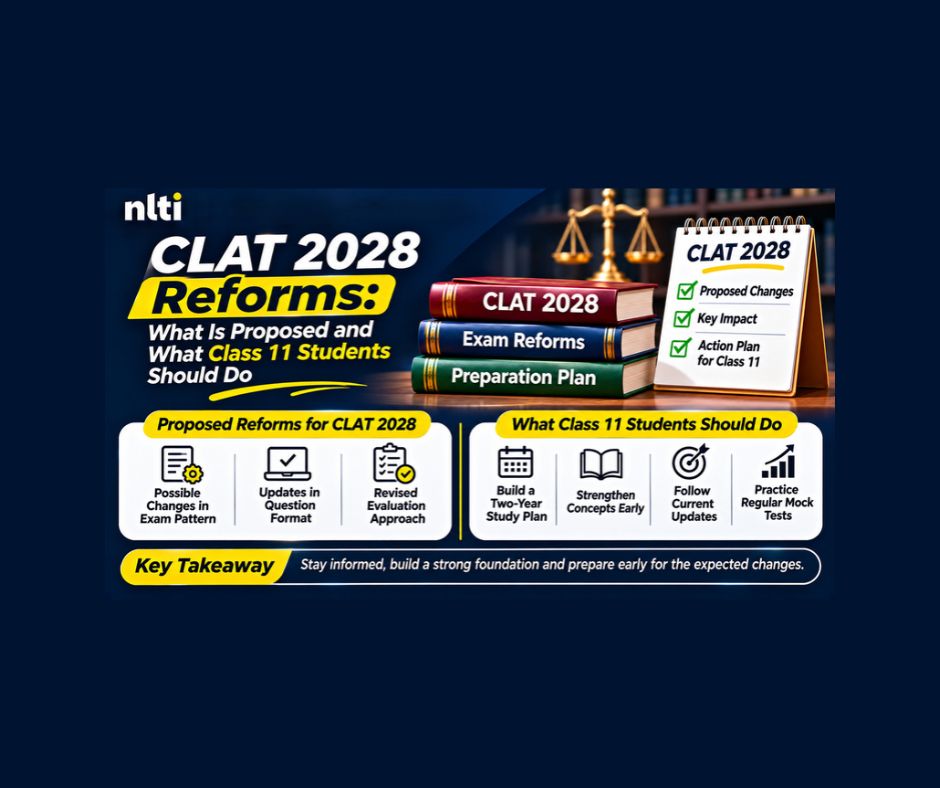
Few CLAT topics have unsettled students as much as the proposed CLAT 2028 reforms. One headline says general knowledge may go. Another says the paper could shrink to three sections.
If you are in Class 11, you need to know what is only a proposal, what is official and how to prepare without guessing. This guide separates the two and gives you a plan that works whichever way the CLAT 2028 reforms are decided.
Best CLAT Coaching Online 2027–2028 by NLTI
What Are the CLAT 2028 Reforms?
The CLAT 2028 reforms are recommendations made by an Expert Committee that the Consortium of National Law Universities set up in September 2025 to review how CLAT tests students. Justice Indu Malhotra (retd.), a former Supreme Court judge, chaired it.
The committee studied the exam after repeated court cases over disputed questions and answer keys. Its report was published in July 2026 for public feedback v and the Consortium has not made any of its structural proposals final.
Remember this one line: the CLAT 2028 reforms are proposals, not rules.
Timeline of the CLAT 2028 Reforms So Far
The CLAT 2028 reforms are therefore still under review and that review involves more than the Consortium alone.
What Is Official and What Is Not
One news report says the Consortium has held all the structural changes back, while the official press release says it will engage with them for CLAT 2028. Both agree on the key point: no final decision has been announced.
CLAT 2028 Study Plan for Class 11 Students: Month-by-Month Roadmap
The Proposed UG Paper in the CLAT 2028 Reforms
The biggest proposal is to replace five sections with three. The table compares today's paper with the version in the CLAT 2028 reforms.
Three sections of 10 to 15 questions suggest roughly 30 to 45 questions in total.
That is our arithmetic, not a figure the committee has stated. The summaries we reviewed also do not state marks or negative marking, so do not assume the current scheme carries over.
Why the CLAT 2028 Reforms Drop General Knowledge
The committee argues that the present paper leans on factual recall. A 2025 Supreme Court judgment criticised the way some questions were framed and the report cites that concern. In short, the CLAT 2028 reforms aim at reasoning, comprehension and fairness rather than memory.
What the CLAT 2028 Reforms Mean Section by Section
Language and Comprehension: moves beyond grammar and vocabulary towards tone, inference and judging arguments.
Logical Reasoning and Legal Aptitude: merges two sections, so legal questions and reasoning questions would sit together.
Quantitative Techniques: shifts from advanced mathematics to aptitude-based numerical reasoning, such as data interpretation and pattern recognition.
Essay: not recommended for immediate introduction, though the committee suggests a roadmap for later cycles.
Notice what is common to every section: passages, reasoning and careful reading. That is the core of the CLAT 2028 reforms.
Other CLAT 2028 Reforms Beyond the Syllabus
Not every proposal changes what you study. The report also covers how the exam is run:
Professional paper setting and stronger quality control.
Publication of sample papers.
Permanent governance structures and a steering committee to oversee implementation.
For CLAT PG, two new components: Legal Knowledge and a descriptive Problem Question.
These institutional CLAT 2028 reforms matter because most court disputes came from question quality, not syllabus.
CLAT 2028 Eligibility Criteria: Marks & Age Limit
Three Scenarios for the CLAT 2028 Reforms and How to Prepare
Instead of guessing, plan for three outcomes of the CLAT 2028 reforms. This framework is our own suggestion, not an official one.
The core of B and C is the same, so you lose nothing by building those skills first.
If you must pick one priority today, pick the skills in scenario B because they also pay off in A and C. Under any version of the CLAT 2028 reforms, strong readers have the advantage.
What Class 11 Students Should Do About the CLAT 2028 Reforms
You have roughly a year before the exam is expected in December 2027, so use the time on skills that every version of the CLAT 2028 reforms rewards.
Build reading stamina. Read one long editorial and article daily and note the argument in two lines.
Practise passage-based reasoning. Argument questions and legal principle questions both test the same habit of reading carefully.
Strengthen numerical aptitude. Work on percentages, ratios, tables and graphs rather than advanced formulae.
Keep a light news habit. Even if GK is dropped, news improves vocabulary and legal awareness. If it stays, you are ahead.
Review official sources monthly. Check the Consortium website, not forwarded messages.
Our CLAT 2028 exam pattern guide and legal reasoning strategy go deeper on both skills.
Myths About the CLAT 2028 Reforms
"GK is already gone." No. It is part of CLAT 2027.
"The paper will have only 30 questions." That is a rough reading of a proposal, not a decision.
"Coaching will become useless." The committee hopes to reduce cramming, but guided practice in reading and reasoning still matters.
"The CLAT 2028 reforms are final." They are not.
CLAT 2028 Logical Reasoning: Preparation Guide
What Not to Do Because of the CLAT 2028 Reforms
Do not drop current affairs entirely on the strength of a proposal.
Do not buy expensive materials built around an unconfirmed three-section pattern.
Do not panic over question counts because they are not final.
Do not treat coaching advertisements as official announcements.
When Will the CLAT 2028 Reforms Be Decided?
No date has been announced. The most likely moment is the CLAT 2028 notification, which came in July for CLAT 2027, so July 2027 is the earliest reasonable estimate. That is an expectation, not a promise.
Students in Class 11 should prepare for a decision close to the registration period, which means roughly eight months of preparation before the pattern is confirmed. Our CLAT 2028 overview tracks the timeline.
Do the CLAT 2028 Reforms Affect Class 12 Students?
Class 12 students writing CLAT 2027 on 6 December 2026 face the existing pattern. Droppers who plan to retake the exam are in a different position because they would sit CLAT 2028 and should watch the reforms closely.
Prepare for the CLAT 2028 Reforms With NLTI
Skills beat speculation. At NLTI, our Starter's Program is aimed at beginners and Class 11 students, with one-to-one mentorship from NLSIU mentors. Read our beginner's guide to CLAT preparation, then explore NLTI's CLAT coaching and start your preparation today.
FAQs
1. What are the CLAT 2028 reforms?
They are recommendations by the Expert Committee, including a three-section UG paper, removal of GK and Current Affairs and better paper-setting. None is final.
2. Will the CLAT 2028 reforms remove GK?
It has been proposed but the Consortium has not confirmed it. CLAT 2027 keeps the section.
3. Will CLAT 2027 change because of the CLAT 2028 reforms?
No. The Consortium has said the syllabus and pattern stay unchanged for CLAT 2027.
4. How many questions will CLAT 2028 have?
Unknown. The proposal suggests 10 to 15 questions per section but the final number is not decided.
5. Should Class 11 students stop reading current affairs?
No. Keep a light habit until the Consortium confirms the CLAT 2028 reforms.
6. Where can I follow official updates on the CLAT 2028 reforms?
On the Consortium of NLUs website, which published the report and the press release.
Read Next on NLTI
Get In Touch
Have questions? We'd love to hear from you. Send us a message and we'll respond as soon as possible.