NLSAT 2027 vs CLAT UG: Key Differences & Strategy
Share this article:
Admission facts checked on 20 November 2026
Summary
CLAT UG 2027 is the route to five-year law programmes after Class 12. NLSAT-LLB 2027 is the route to NLSIU Bengaluru’s three-year law degree after graduation. See how the exams compare on eligibility, difficulty and marking, then use a worked legal question and a study plan to decide what to practise first.
If you want to study law at NLSIU Bengaluru, start with one question. Are you applying after Class 12 or after a bachelor’s degree? That determines whether to look at CLAT UG or the National Law School Admission Test for Bachelors of Laws (NLSAT-LLB).
The next decision is what to practise. Both exams reward careful reading, but a habit that protects your CLAT score can cost you marks in NLSAT. Leave four multiple-choice questions blank and CLAT UG deducts nothing. In NLSAT Part A, those four blanks cost one mark. Here’s how the NLSAT 2027 vs CLAT UG comparison changes your mock strategy, writing practice and study plan.
Check Out NLSAT Coaching and Mentorship by NLTI
NLSAT 2027 vs CLAT UG at a glance
Quick answer
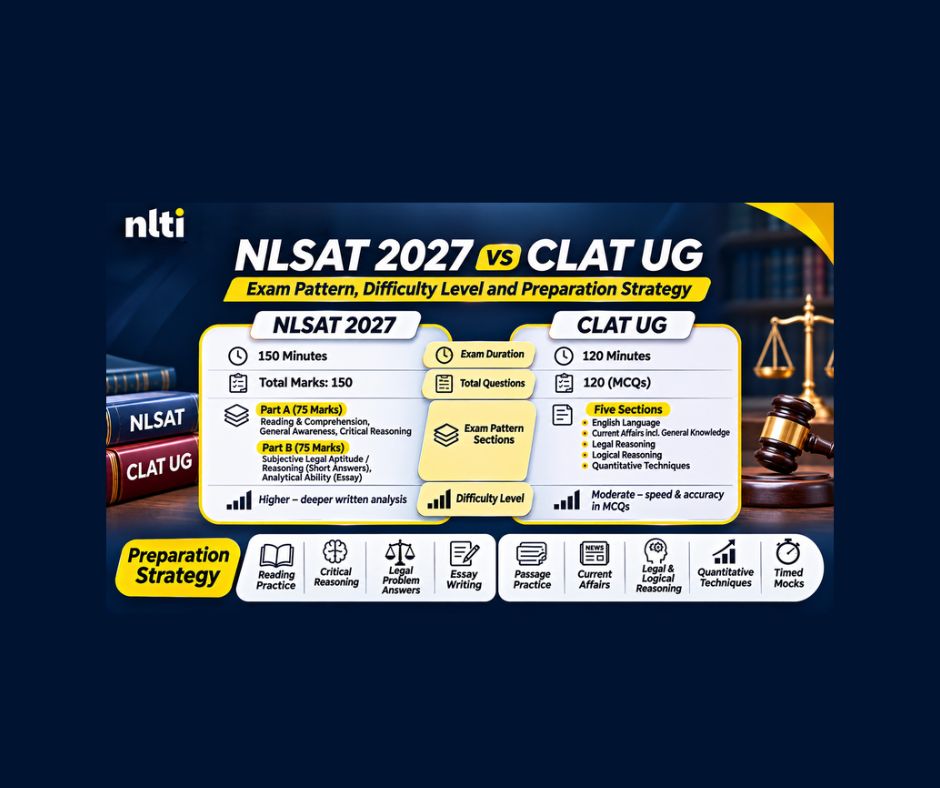
NLSAT-LLB is the entrance exam for NLSIU Bengaluru’s three-year LL.B. (Hons.), a graduate-entry law degree. CLAT UG is the entrance exam for five-year integrated law programmes at participating National Law Universities (NLUs). NLSAT combines multiple-choice questions and written responses. CLAT UG has 120 multiple-choice questions.
Both exams serve the 2027–28 admissions cycle, with CLAT 2027 sitting in December 2026.
Jump to · Eligibility · Marking · Difficulty · Study plans
Which exam should you take after Class 12 or graduation?
Your qualifying examination is the school or university exam used to check your minimum marks for admission.
After Class 12, take the five-year integrated route
CLAT UG 2027 requires 45% in Class 12 or equivalent, or 40% for SC, ST and PwD candidates. Students appearing for their qualifying exam in March or April 2027 can apply and must produce proof of passing at admission. When you shortlist NLUs, open each university’s brochure and check its degree options, intake and seat categories.
In your final year or after graduation, consider the three-year route
NLSIU accepts bachelor’s degrees from recognised universities in any discipline. The minimum aggregate is 45% for General and EWS candidates and 40% for SC, ST, OBC-NCL and PwD candidates. If you’re in the last year of a B.Com., you can apply while awaiting your results.
Your offer depends on completing the degree with the required marks and submitting proof by 31 December 2027. NLSAT applications close at 11:59 pm IST on 23 March 2027. NLSIU’s 2027 LL.B. (Hons.) admission notification
If you’re starting from scratch, use the NLSAT 2027 beginner’s guide to put your first week of practice together.
Can a graduate still take CLAT UG?
Yes. The Consortium sets no upper age limit for CLAT UG. A graduate who meets the Class 12 eligibility rules can apply for a five-year programme. CLAT PG serves a separate route into postgraduate law programmes such as the LL.M. and has a law-degree eligibility requirement.
Exam pattern, syllabus and marking scheme
Both exams test whether you can follow an argument. The format changes how you show it.
NLSAT Part A and Part B
Part A covers Reading and Comprehension, General Awareness and Critical Reasoning. Part B tests legal aptitude through short written answers and analytical ability through an essay. For a legal problem, connect the given rule to the fact that decides the outcome.
For the essay, take a clear position and explain how it holds up against a serious objection. NLSIU expects no prior legal knowledge for either writing task. Both parts sit within the same 150-minute paper.
How Part B shortlisting and final merit work
Part A: You need to score above zero. NLSIU then ranks eligible candidates by Part A performance and evaluates Part B for five candidates per available seat in each category.
Final merit: NLSIU ranks candidates by their combined Part A and Part B marks. To receive an admission offer, you must score above zero in both parts. On the combined score, you must also be above the 75th percentile of eligible candidates for General and EWS, or above the 40th percentile for SC, ST, OBC-NCL and PwD.
Ties: The higher Part B mark determines rank when candidates have the same combined score.
The percentile thresholds govern eligibility for admission. The score of the last admitted candidate depends on rank and seat availability. Write both parts on exam day. Part A determines whether your written responses will be evaluated.
CLAT UG’s five sections
CLAT UG covers English Language, Current Affairs including General Knowledge, Legal Reasoning, Logical Reasoning and Quantitative Techniques. Quant asks you to extract information from short sets of facts or numerical representations and apply basic maths. Legal Reasoning asks you to identify and apply principles from the passage. For section-by-section practice, use the CLAT 2027 exam pattern and marking scheme guide. Consortium’s CLAT UG syllabus
What happens if you skip four questions?
To calculate your mock score, start with the number correct. Deduct 0.25 for every wrong answer in both tests. For NLSAT Part A, also deduct 0.25 for every blank. If you got 50 right, 15 wrong and left 10 blank on a full NLSAT Part A, your score is 43.75 out of 75.
Pro tip
Log wrong answers and blanks in separate columns. If the blanks cluster at the end, check your pacing. If they cluster around one question type, try that type untimed and see where you get stuck.
NLSAT 2027 Current Affairs: Legal & National Issues
Is NLSAT harder than CLAT UG?
Quick answer
NLSAT can feel harder if you struggle to write concise legal answers or finish an essay under time pressure. CLAT UG can feel harder if switching between timed passages, reasoning questions and numerical sets slows you down. A timed diagnostic in each format tells you where your preparation needs more work.
The difficulty depends on what slows you down
If you can spot the right option but struggle to explain why an exception applies, practise short written responses. If you spend too long choosing between two options, use timed passage sets and decide when to move on.
Paper difficulty and competition for seats
NLSIU’s notified intake is 120 for its three-year law programme. CLAT UG covers multiple NLUs, so admission prospects depend on the institution, programme, category and preferences. Use timed papers to judge exam difficulty and official seat and allotment information to assess admission prospects.
Try one legal scenario in both formats
Practice rule. A community centre refunds a booking deposit if the organiser cancels at least 48 hours before the event. An exception allows a refund after that deadline if the centre’s building closes before the event and the closure prevents it from going ahead.
Facts. Riya cancels 24 hours before her workshop because the trainer is ill. Three hours before the workshop’s scheduled start, a pipe bursts and the centre closes. The booking had already been cancelled.
CLAT-style question. Is Riya entitled to a refund under the stated rule?
A. Yes, because the trainer’s illness was outside her control.
B. Yes, because the building closed before the scheduled start.
C. No, because she cancelled late and the closure did not cause the workshop to be cancelled.
D. No, because a deposit is never refundable after the deadline.
<details> <summary>Reveal the answer and Part B model response</summary>
CLAT-style answer · C. Option B is tempting because the closure happened before the start time. The exception also requires the closure to have prevented the workshop. By then, Riya had already cancelled it.
NLSAT-style model answer. The issue is whether the building-closure exception applies to Riya’s late cancellation. Under the general rule, she needed to cancel at least 48 hours before the workshop. She cancelled only 24 hours before it. The pipe burst before the scheduled start, which satisfies the timing requirement for the exception.
But Riya had already called off the workshop because her trainer was ill, so the closure did not prevent it from going ahead. She is therefore ineligible for a refund under the stated rule.
Editorial feedback. The most important sentence links the order of events to the cause of the cancellation. If your answer only says “the workshop was already cancelled,” add what caused the cancellation and show how that fact affects the exception.
</details>
Use the same approach to develop the position and counterargument in an essay. Try a timed prompt from NLTI’s NLSAT analytical writing practice guide.
What can you prepare together?
Use one editorial to practise reading and reasoning for both exam formats.
Shared skills in reading, reasoning and current affairs
Pick an editorial on a policy issue, such as whether a city should restrict private vehicles around schools.
Write the author’s conclusion in one sentence.
Identify one assumption, such as whether families have a workable travel alternative.
Summarise the issue and its main trade-off in two sentences.
For CLAT, write a four-option inference question and explain why the closest distractor fails. For NLSAT, write a short argument that addresses an objection from a family affected by the policy.
Work that needs its own practice block
CLAT UG: Rotate timed MCQs, short Quantitative Techniques sets and section-order trials. Use two comparable mocks to see if your chosen order leaves enough time for the final section.
NLSAT: Recalculate Part A using the penalty for blanks. Write legal answers and essays under time limits, then rewrite the weakest paragraph. Track whether you finish Part B within the overall paper time.
If you have already prepared for CLAT
Take a timed NLSAT sample and write one legal answer before looking at a model response. If your Part A score falls because of late blanks, work on pacing. If your written answer reaches the right conclusion but skips the exception, work on showing how the facts satisfy each condition. Use NLTI’s guide to switching from CLAT prep to NLSAT to plan the adjustment.
Preparation strategies for the 2027 cycle
Use a timed sample to decide what to practise next.
For CLAT, choose a recent baseline from NLTI’s CLAT previous-year papers and analysis. For NLSAT, adapt the NLSAT 2027 study timetable around your college or work commitments.
A first-week checklist
Days 1–2: Take a timed baseline and pick your two most costly weaknesses.
Days 3–5: Run two short drills on those weaknesses. Include Quant if it costs you CLAT marks or a timed written answer if you’re taking NLSAT.
Day 6: Retest using a comparable set. For NLSAT, also outline an essay with one counterargument.
Day 7: Compare the results and schedule the next week’s first two sessions.
Two mock-review entries you can copy
CLAT entry. “I spotted the rule but missed the exception. In the next set, I’ll underline each exception before I look at the answer choices.”
NLSAT entry. “I wrote, ‘Riya gets no refund because she cancelled late.’ My rewrite is, ‘Riya cancelled only 24 hours in advance because her trainer was ill. The centre closed after the cancellation. The closure exception therefore does not apply.’” In your next answer, put the decisive fact beside the condition it addresses.
Common mistake
Starting a second full mock before reviewing the first makes it harder to tell which change helped. Pick one behaviour to test, such as moving on from a stalled Quant set or leaving enough time for the essay.
CLAT 2027: 30-Day Strategy Based on Mock Scores
If you missed CLAT 2027 registration
Fresh CLAT 2027 registrations closed at 11:59 pm IST on 7 November 2026. Candidates who had already started registration could pay the fee and complete the process until 11:59 pm IST on 10 November 2026. If you’re planning for the next five-year law admission cycle, see NLTI’s CLAT 2028 vs AILET 2028 comparison. Consortium’s revised deadline notice
Why Trust NLTI
Students at NLSIU Bengaluru founded the National Law Training Institute in 2022. NLTI has worked with law entrance aspirants since then, using mock review, mentorship and practice across CLAT, AILET and NLSAT. Our aim after each mock is to help you choose the next task you can act on.
For a CLAT student, that could be finding which passage consumed too much time. For an NLSAT student, it could be rewriting one sentence so it explains how the facts support the conclusion. About NLTI
What feedback can look like
Try the free legal scenario above, then compare your answer with the model. As one public example of a student’s experience, Mehak Ahmed, AIR 1 in NLSAT 2026, credited NLTI and her mentors with helping her refine her strategy. In a Careers360 interview, she described using weekends for mocks or sectional tests and revision.
For help reviewing your work, compare the written evaluation and mentorship listed under NLSAT mentorship and test options or the mock and debrief support under CLAT coaching and mock support. For corrections to this guide, write to support@clatnlti.com.
Conclusion
Schedule your first mock today. For the five-year route, take a two-hour CLAT UG paper and note where you spend too long. For the three-year route, take a 150-minute NLSAT paper and review your Part A blanks and Part B writing.
Frequently asked questions
1. What is the main difference between NLSAT and CLAT UG?
NLSAT-LLB is for NLSIU’s three-year law degree for graduates and includes written answers. CLAT UG is for five-year integrated law programmes and uses multiple-choice questions throughout.
2. Can I take CLAT UG after graduation?
Yes. CLAT UG 2027 has no upper age limit. Graduates who meet the Class 12 eligibility rules may apply for the five-year programme.
3. Can Class 12 students apply for NLSAT-LLB 2027?
No. The three-year LL.B. requires a bachelor’s degree. Students in their final year of a bachelor’s programme may apply subject to NLSIU’s completion and proof requirements.
4. Can CLAT preparation help with NLSAT?
Yes. Reading comprehension, reasoning and following current affairs carry over. Add NLSAT-specific practice for Part A scoring, short legal answers and the analytical essay.
5. Does NLSAT have a maths section?
NLSAT-LLB 2027 has no standalone Quantitative Techniques section. CLAT UG has a separate Quantitative Techniques section.
6. Does NLSAT deduct marks for unanswered questions?
Yes. NLSAT Part A deducts 0.25 marks for each unanswered question. An unanswered CLAT UG question carries zero marks.
7. How does NLSIU decide whose Part B gets evaluated?
You need a Part A score above zero. NLSIU ranks eligible candidates on Part A and shortlists five candidates per available seat in each category for Part B evaluation.
8. Does NLSAT Part B require prior knowledge of law?
No. NLSIU tests your ability to reason through legal problems and write a coherent essay. Apply the facts and principles in the question and explain your reasoning.
9. When are CLAT UG 2027 and NLSAT-LLB 2027?
CLAT UG 2027 is scheduled for 6 December 2026, from 2 to 4 pm IST under standard timings. NLSAT-LLB 2027 is scheduled for 25 April 2027.
Suggested internal links used
Key takeaways
Choose by degree route. CLAT UG serves the five-year route after Class 12. NLSAT-LLB serves NLSIU Bengaluru’s three-year route after graduation.
Score your mock by the right rules. A blank costs 0.25 marks in NLSAT Part A and zero in CLAT UG.
Practise what your test asks you to do. Keep reading and reasoning in both plans. Give timed MCQs and Quant their own CLAT sessions and write legal answers and essays for NLSAT.
CMS notes
Keep the FAQs visible on the page. Google removed FAQ rich results in May 2026. Use BlogPosting and BreadcrumbList in the CMS with the confirmed author, dates, image and canonical URL.
The paired legal scenario and mock-review entries are original practice examples. Assign the final byline and named reviewer after review. The exact package used by Mehak Ahmed was not confirmed in the sources, so her public account is used without naming a package.
Check the existing comparison URLs in Search Console before setting the final canonical. Confirm CMS canonicals for linked guides, refresh the linked timetable’s school references for graduate-entry readers, and update the CLAT date phrasing after 6 December.
Get In Touch
Have questions? We'd love to hear from you. Send us a message and we'll respond as soon as possible.